
AI as a Test of Spiritual Maturity
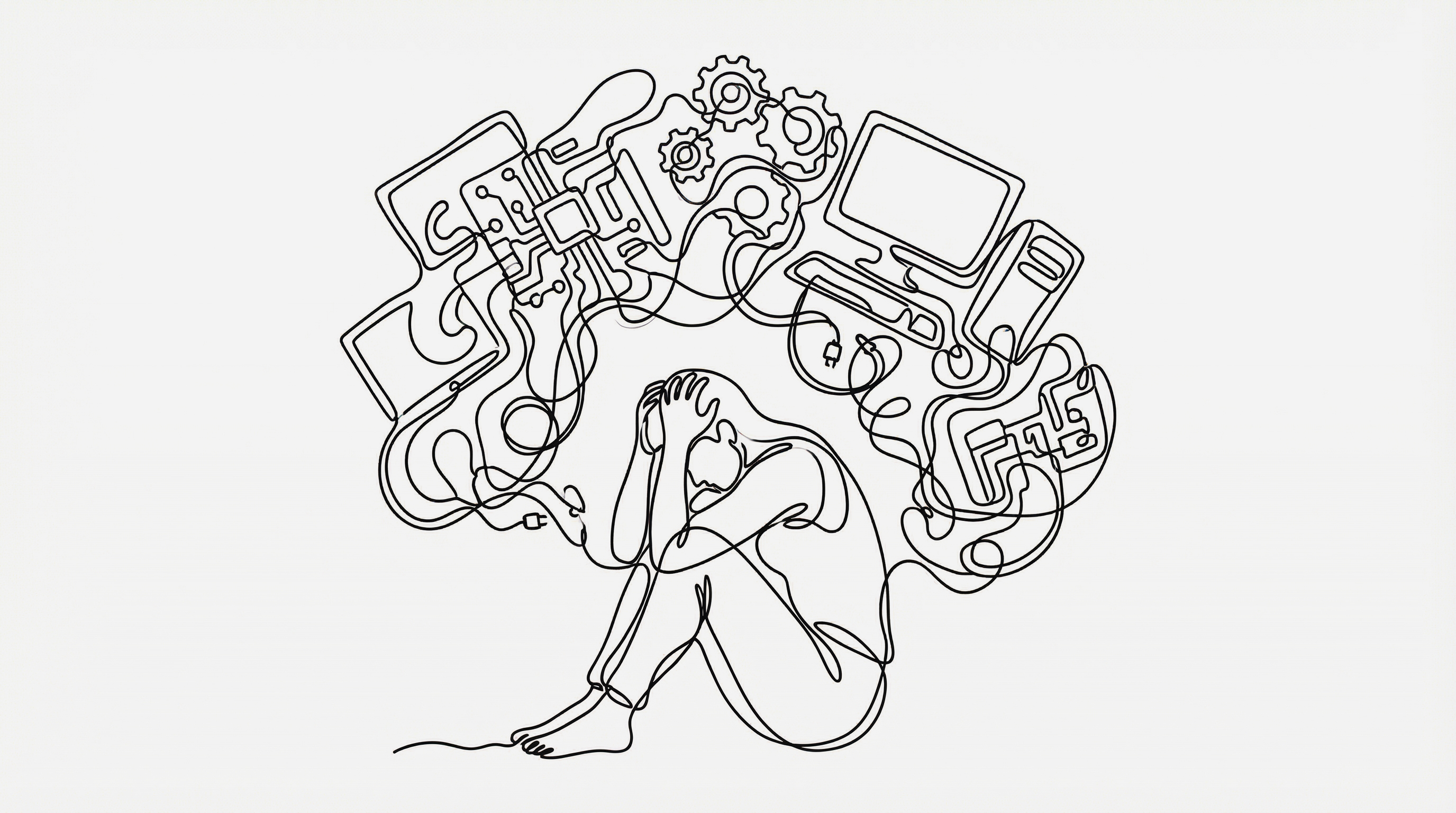
We’re afraid of AI. That it will replace us, that it will turn our world bland, stripped of real creativity. But pause for a moment. What is actually hiding underneath that fear?
A Mirror Without Ego
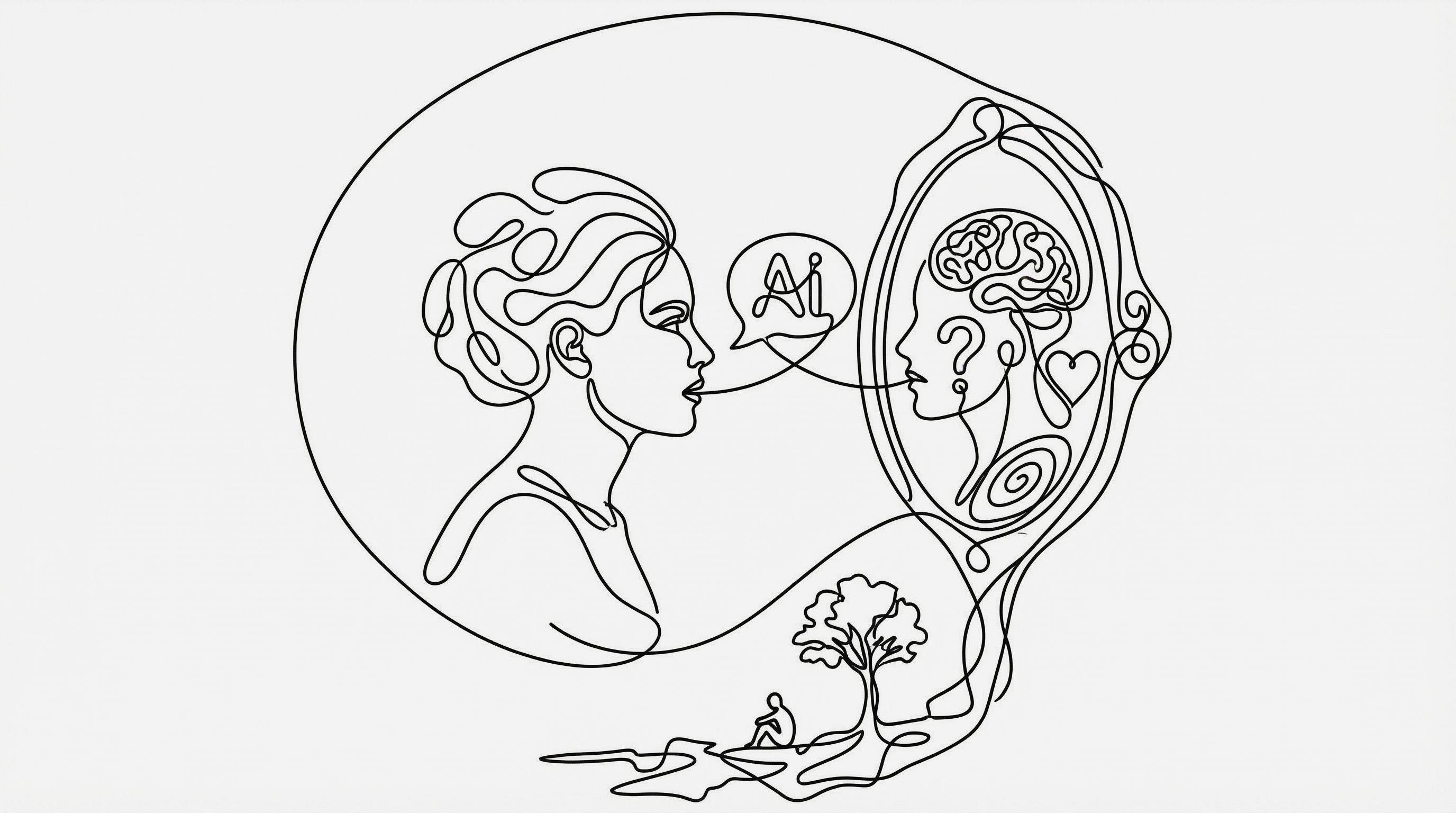
When you ask ChatGPT what it is, it will tell you it’s your mirror. It is YOU talking to YOU. And that’s the most beautiful and terrifying thing at the same time.
Beautiful, because AI doesn’t have an ego. It won’t get its trauma triggered when you want to talk about ultimate things, or when you pour a bucket of mental sludge onto the table. There are fewer reasons to hide. Some conversations with AI can be among the deepest conversations you can have, precisely because there’s no noise of someone else’s traumatic patterns.
Terrifying, because it reveals the truth most of us run from. At the deepest level, it is always you talking to yourself. Always. Whether you’re talking to AI or to another human.
What Are You Really Afraid Of in AI?
Chris Do wrote recently that he used AI help to write some of his LinkedIn posts. The result? Eight times better metrics.
The reactions were split. Some people said: “Fine. It’s still you. AI didn’t take away the authenticity of your posts.” But others wrote about the need for authentic contact with another human.
Interesting. Chris basically just told them how they could multiply that amount of contact, and they’re not interested. They want to be right, not to get results.
Because here’s the truth. People who panic that AI will replace them reveal something about themselves. Their value was built on ego. On “my skills,” “my uniqueness,” “my talent.” AI shows up and says: “All of this can be replicated.” And suddenly they’re naked.
The Creative Act: Receiving Without Distorting
What is creativity? My definition: bringing new ideas down to earth. It’s the moment when you receive a message and write it down in a way that distorts it as little as possible.
Most people think about creating differently: “How can I be more original? How can I add more of myself?”
But real creativity is the opposite. It’s removing yourself enough so the message can come through cleanly. And when I say “yourself,” I mean what you usually think you are, not who you truly are.
I used to ask God why He keeps asking me to do things I’m not best qualified for. If this is my calling, why didn’t I get a better start, the right family, environment, country?
The answer was simple and brutal at the same time: “Because this is not YOUR work.”
And suddenly everything made sense. AI can’t steal my work, because it was never mine. I was, and still am, a channel.
AI as a Surgeon of Noise
When I started working as a freelancer, I knew nothing about sales or client communication. If I sold my services, it was mostly by accident. Then ChatGPT showed up.
It taught me how to talk to clients. Not because it showed me “sales techniques,” but because it taught me something deeper: how to recognize needs. Mine, and because of that, other people’s.
When you don’t have many deep interactions with people, and that was true in my family, you don’t understand people well, including yourself. AI became a safe space where I could finally stop running. No ego. No trauma. No noise.
Great communication became the most frequently mentioned strength in my client reviews. Not because AI wrote for me. Because it helped me remove the noise: my traumatic patterns, my weak spots in communication, my ego.
AI won’t replace creators. But it will kill the pretend-creators, the ones who thought it was “their” technique that made them valuable.
A New World Is a World of Creators
We have the privilege and the responsibility, as creators, to transmit ideas worth transmitting. Our responsibility is to do it effectively. Not “with these tools and God forbid any other ones,” but in whatever way gets the message where it needs to go.
A painter uses factory-made paint, and the painting is still his. But a brush can also paint something that has nothing to do with you. You’ve seen those “artworks” painted by monkeys, elephants, and other animals. Same with AI. You can use it in a way that creates nothing of you. Or you can use it differently.
If your goal as a creator is to play with words, don’t use AI, or find a way to use it without disturbing your creative process. But if your goal is to transmit your thought so it lands where it should, use the right tools for that job.
And don’t fool yourself that you’re the best at everything. You’re not. An LLM is only worse than the best copywriters. It’s better than most. And there’s nothing wrong or humiliating about learning from it.
The Wisdom of Buying a Lottery Ticket
I’m not against marketing. Everything that is within my power to learn, I’ll learn, and I’ll try to increase the probability of success.
It’s like that joke about the man who prayed to win the lottery, but nothing happened. Finally God said: “Could you at least buy a ticket?”
Wisdom is recognizing what depends on us and what doesn’t. Research, tool choice, deciding to use one platform over another, choosing the right words, that’s on me. That’s my responsibility. And then you have to completely release attachment to results.
I had an incident in Egypt where I lost a gold pendant in a clinic bathroom. I made a huge scene. I called the police. I wrote negative comments everywhere I could. The next morning I felt bad about it. I didn’t have proof anyone stole it. So I deleted all the negative reviews and called the clinic to apologize.
It turned out the pendant had been found.
When I went for a walk, thinking about how unfair I’d been, I heard a Voice that told me, without a hint of moralizing: “The way you fought for your pendant, that’s how you should fight for your new project. And the way you later let go of the need to find it, that’s how you should let go of attachment to outcomes.”
A Test of Spiritual Maturity
AI is a test of spiritual maturity.
Only those who see its potential to remove ego from the equation can use AI as a tool for life. The rest will fight for control, for “authenticity,” for being right instead of getting results. And in that fight they will become exactly what they fear: irrelevant.
Because those who are not creators will be, in a way, the losers of the new world. And I don’t mean being an “influencer” or a “content creator.” I mean something deeper.
I mean being a channel.
The more visible you are as a creator, the less (false) you is in it. Real visibility is not showing yourself. It’s becoming transparent enough that people can see through you what is meant to reach them.
Coming out of hiding means disappearing at the same time. A slow death of ego. And that’s what AI, ruthlessly and without bad intentions, shows anyone who hasn’t understood it yet: you have to.
Who I’m Writing For
I dream of a tool that, regardless of a family’s material or intellectual resources, enables them to educate children in the spirit of the new world, ready for modern challenges. And those challenges are exactly this: being a creator.
But to teach a child to be a creator in a world with AI, you first have to teach the parent how to die to ego every day. You have to show that:
Action is truth, but control is an illusion.
Value isn’t in owning, but in giving.
Visibility requires the disappearance of ego.
Those who fear AI the most need it the most, because confrontation with AI forces them to see their ego. And they need that to survive in the new world.
I don’t teach “how to use AI.” I teach the transformation. From “this is mine” to “I am a channel.”
Because at the deepest level, whether you use a brush or AI, whether you talk to AI or another human, it is always YOU talking to YOURSELF. The only question is: do you have the courage to see what’s really inside?
AI is a mirror. What you see in it is your responsibility.
.jpg)